Spotlight on the European hornet

European hornets may look intimidating, but these ‘gentle giants’ are valuable native insects. Discover how they support pollination, help gardeners, and differ from the non-native Asian hornet.

Few insects command attention quite like the European hornet. Large, loud and boldly marked, they can appear fearsome at first glance, yet despite their appearance they are often misunderstood. Far from being a creature to fear, the European hornet is a valuable part of our natural world: a pollinator, a predator and a gardener’s friend.

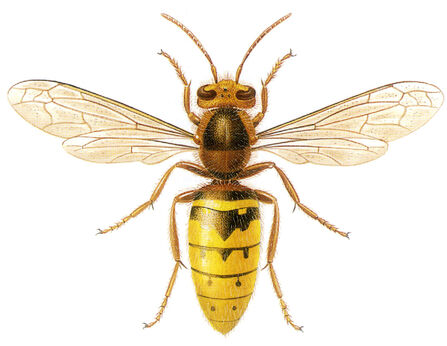
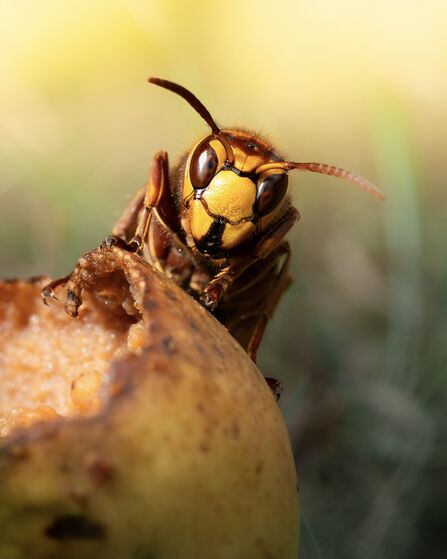
The European hornet is the UK’s only native hornet and is significantly larger than the common wasp. Its distinctive appearance is designed to signal danger: a yellow abdomen crossed with black stripes, a yellow and red head and a reddish-brown thorax. This bold colouring is so effective as a warning signal that other harmless insects, including the hornet moth and hornet mimic hoverfly, have evolved to mimic it. 

Despite their appearance, they are far less aggressive than common wasps and are unlikely to sting if left alone. In fact, they’re often considered to be ‘gentle giants’, far more interested in feeding and hunting than bothering us. They will, however, defend their nest if threatened.
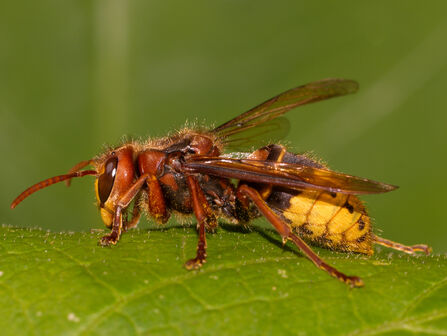
Hornets active during August and September, making now a great time to see them. During these months, reproductive males and queens develop and leave the nest to mate. When winter draws in, the males and previous queens die, leaving the new fertilised queens to hibernate, ready to emerge next spring and start the cycle again. 

They feed on high-energy foods such as nectar, sap and fallen fruit, while also hunting a wide range of invertebrates to feed their larvae. In doing so, they help regulate populations of other insects, including some that feed on garden plants. This makes them a useful ally for gardeners. 

The European hornet lives in a wide variety of habitats, from woodlands, grasslands and heathlands to our towns and cities. Their ‘paper nests’ nests can be found in hollowed-out trees and cavities in buildings, and are made from pulp created by chewing wood.

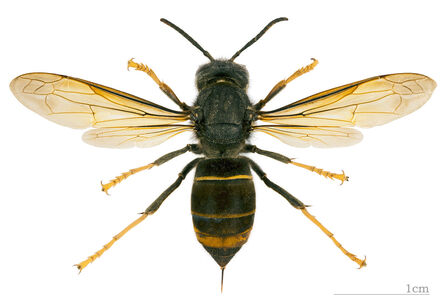
In recent years, the non-native Asian hornet has started appearing in the UK. Although rare, it poses a risk to our native wildlife. Asian hornets are smaller than European hornets, darker overall, and have a distinctive orange face. The Asian hornet is more aggressive, especially towards honeybees and other pollinators.

Aid the tracking and control of this species to the UK Centre for Ecology and Hydrology, commissioned by DEFRA: www.ceh.ac.uk/our-science/citizen-science/asian-hornet