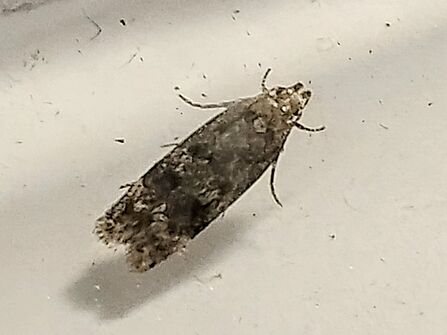
Productive moth trapping sessions recorded at least 20 new species for the site, with several more still awaiting identification. One session in early July alone recorded a massive 305 species, highlighting the incredible diversity that Pamber supports.
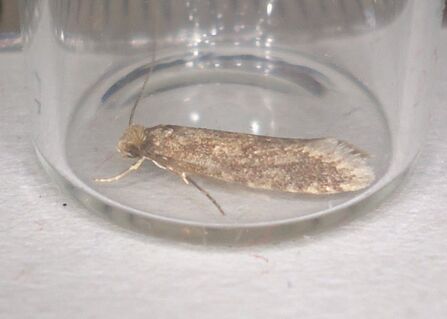
Among these, two were new county records: Gelechia scotinella, a small, dark brown mothwith subtle speckling along its wings, and Haplotinea insectella, a pale, yellowish-brown moth with a slightly iridescent sheen and delicate fringe along the hindwings.
Pamber Forest is an exceptional site for moths and other invertebrates. Its ancient woodland, rich in veteran trees, rides, and bracken-covered glades, provides diverse habitats that support a wide range of species. The mixture of shaded areas, open spaces, and a variety of host plants makes it particularly suitable for moths, including many nationally scarce and Red Data Book species (species which are considered rare or under threat in Britain).
The reasons for these discoveries are varied, as Graham Dennis, Reserves Officer (Pamber) at Hampshire & Isle of Wight Wildlife Trust explains: “Many of these new arrivals are undoubtedly due to climate change as they have spread from the south coast or the near continent. Others are accidental introductions that are now spreading rapidly in suitable habitats, a few have probably been here all along but are simply elusive, and so a concentrated effort is more likely to find them.”
All species recorded are micro-moths, which are often overlooked due to their small size and difficulty of identification. “Micro-moths are species that are not easily identified and may be overlooked, so in that sense it’s not that surprising,” adds Graham. “But some really were a surprise, and as not much is known about them, we will have to wait and see if they are recorded again. Most were recorded as single individuals, though Acleris umbrana was recorded on several nights, with up to six in one night.”
The intensive recording sessions rely on a dedicated group of volunteers, or ‘moth-ers,’ who visit the site. They set up light traps powered by generators or batteries, applied highly attractant sugar solutions to tree trunks, and hand-netted or collected moths and larvae to document the full diversity present.
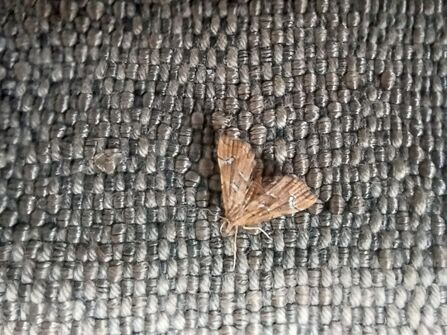
A particularly intriguing species found is Musotima nitidalis, native to New Zealand. Its larvae feed on bracken and other ferns, and its presence at Pamber demonstrates how accidental introductions and range-expanding species are finding suitable habitats in Britain, particularly bracken-rich woodland margins. The adult moth is a striking golden-brown with translucent wings marked by fine, darker veins.
Among the most notable records is Haplotinea insectella, a new county record for Hampshire and a proposed Red Data Book species (pRDB). Its larvae feed on fungi growing on tree trunks, making Pamber’s old timber-rich habitats especially suitable. The adult moth has pale yellowish-brown forewings with a faint dusting of darker scales that give it a subtle shimmer in light.
Gelechia scotinella, the new county record for Hampshire, was previously recorded only from three other counties in Britain so nationally scarce. It is also a pRDB. Its larvae feed on blackthorn shrubs found in woodland rides and edges. The adult is a small, dark chocolate-brown moth with tiny silvery spots along the forewings that glint in the light.
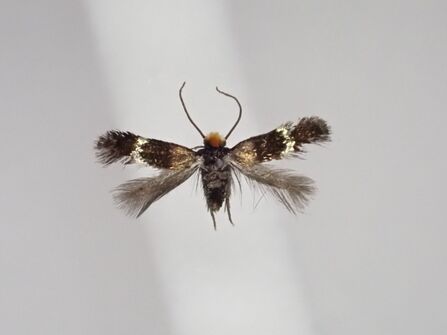
Bohemannia auriciliella is a pRDB and is only the third county record for Hampshire, previously known only from the Wickham area. Its larvae are thought to feed on birch and lime.The adult moth is minuscule, with glossy metallic bronze forewings and a distinctive golden fringe along the edge, giving it a jewel-like appearance.
Bryotropha basaltinella is nationally scarce and is only the second North Hampshire record. Its larvae feed on mosses, abundant on shaded woodland rocks and tree bases at Pamber. The adult moth is dark grey with blackish speckling and a subtle pale streak along each forewing, almost blending perfectly with mossy backgrounds.
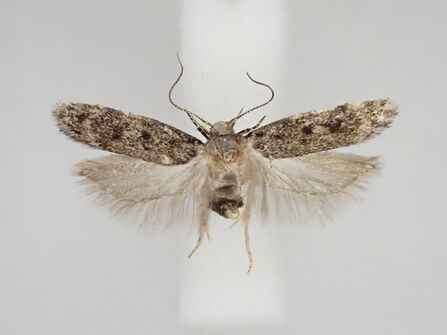
Acleris umbrana is nationally scarce and is the fourth North Hampshire record, recorded on several nights with up to six individuals in one evening. Its larvae feed on shrubs and trees including blackthorn. This moth has mottled brown and grey forewings with a subtle darker band near the edge, making it look like a tiny camouflaged leaf.
Bacotia claustrella is a pRDB and is only the second recent North Hampshire record, also seen in the Fleet area. Its larvae build a portable case and feed on lichens growing on tree trunks. The adult moth is small, with a pale grey-brown body and subtle darker markings that give it a cryptic, lichen-like appearance.
Lyonetia prunifoliella is only the third North Hampshire record. Once frequent in the 19th century, it was absent in the 1900s so presumed extinct but reappeared in 2007, and recorded in Hampshire in 2014 at Greywell Fen, again in 2023, and now at Pamber. Likely tracking northwards under climate change. Greywell Moors Nature Reserve is a nationally important fenland which is part of the larger Greywell Fen SSSI, as area of wet grassland, wet woodland and calcareous fen. It’s larvae mine the leaves of blackthorn and apple, whilst the adults are delicate, silvery-white moths with narrow wings and fine, metallic streaks along the length, almost appearing as miniature pieces of spun glass.
Eidophasia messingiella has only three old records for North Hampshire, and none since the 1990s. Its presence at Pamber adds to its possible re-emergence in the region. The moths are small and pale grey with faint darker markings and a subtle silvery shimmer on the wings.