

© Steve Page
Update on Farlington Marshes
The Trust, since its origins in the 1960s, has been managing Farlington Marshes for its wildlife for over 60 years. This is a vitally important habitat and a haven for wildlife and people that is an exemplar of one of the country’s great coastal wetland sites.
Its success lies in its scale and infrastructure as well as its location. The seawall is multi-functional, protecting the site from inundation by the sea and providing an amazing walking route around the site, offering fantastic views across the reserve and into Langstone Harbour. Public access is limited to the seawall, a connected access track to the site building and cycle way and to some of the smaller field units, the Bushes and Point Field. This means that the majority of the site is left undisturbed, purely for wildlife. A closer look will reveal a mix of habitats across the site that includes, coastal grassland, saltmarsh, fen, reedbed, scrub, freshwater ponds and a saline lagoon. This combination of habitats provides a huge range of niches for wildlife to utilise.
Failing site infrastructure
Sadly in spring 2024 the tidal flaps on site broke which resulted in the site experiencing very high water levels since. The main 8 hectares of reedbed has been inundated by sea water. This very sadly led to the dying back of the reed and the loss of functionality in this area. This coincided with one of the most important times of year for the site with the return of migratory species.
The tidal flaps and sea wall repairs are both the responsibility of the Environment Agency. The Trust and Portsmouth City Council are continuing to apply pressure on the Environment Agency to ensure the reserve is protected for the foreseeable future.
Tidal flap repairs 2024
After escalation of the works to emergency status, Environment Agency contractors carried out temporary repair works to the damaged tidal flaps.
Tidal flap repairs 2026
Earlier this month Environment Agency engineers installed a permanent replacement valve. However, since this work water levels have increased again. Once again the site has been experiencing very high water levels with the main lake area and the former area of reedbed inundated by sea water again.
The Trust is in constant discussion with the Environment Agency. We are trying to find out what has happened and we are working with them to try and find a solution quickly. Works are planned for the 26th and 27th May to make the necessary repairs.
Sea wall
The sea wall around the site is also failing. This current wall built in the 1960’s acts as a flood defence structure protecting the A27, railway and property in Farlington. The reserve provides flood storage for water flowing from springs and streams as well as surface water from the Farlington area. However, the wall needs serious work to maintain its functionality. The future of the sea wall and the plans to upgrade the wall are still being developed by the Environment Agency. This is a hugely expensive and complicated process and coinciding with a time when the realities of climate change are becoming all too apparent.
There is still hope
Staff and volunteers continue to work hard to try and help the wildlife that calls Farlington home. Staff will be doing all they can to help the breeding birds at Farlington. After the reedbed was washed out in 2024, bearded tit nest structures were created to compensate for this loss and to give the bearded tits a helping hand. We were delighted to find that some bearded tits utilised some of the homemade nest structures. We're hoping they will use them again this year. And the other wading birds will have another chance to nest and raise their young on the main marsh.
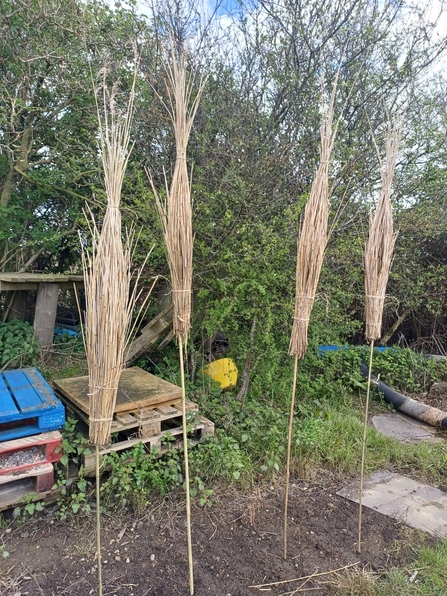
Homemade bearded tit nest spots before being installed at Farlington © HIWWT
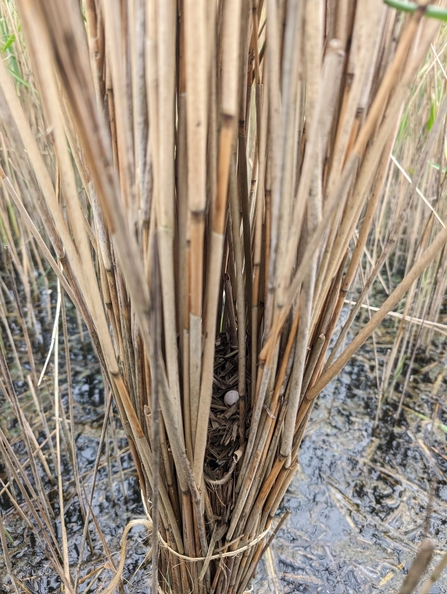
Homemade beared tit nest spot at Farlington with a bearded tit egg laid inside © HIWWT
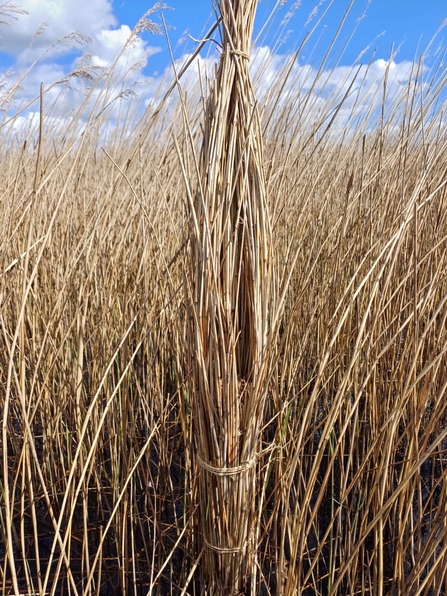
Homemade beared tit nest spot in place at Farlington © HIWWT
2024 breeding bird update
Summer ringing activities saw 54 lapwings, 12 avocets, 9 redshanks, and 31 black-headed gulls ringed. Additionally, at least three oystercatcher chicks were observed with one of those chicks being ringed marking a first for Farlington. A ringed plover was also seen attempting to nest. This further highlights the reserve’s role as a critical breeding ground for these species.
Swans also bred at Farlington with cygnets observed on nest and three reed warbler nests were also observed at various stages.
The breeding birds at Farlington defied the odds and adapted to the site conditions and continued to breed. The Trust was delighted with this year's breeding season. However, sadly wildfowl and wader numbers this winter are low with birds seeking alternative sites for food and refuge.
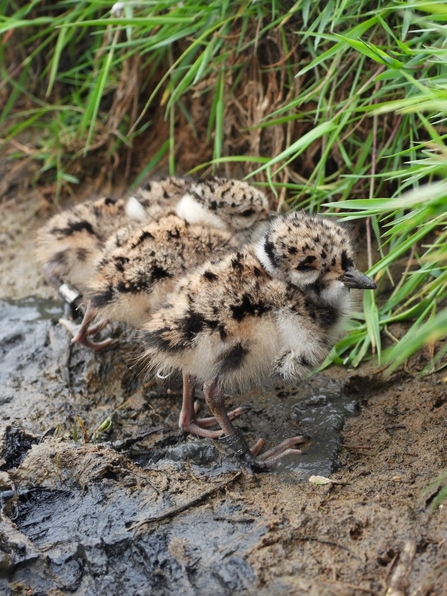
Three lapwing chicks at Farlington © HIWWT
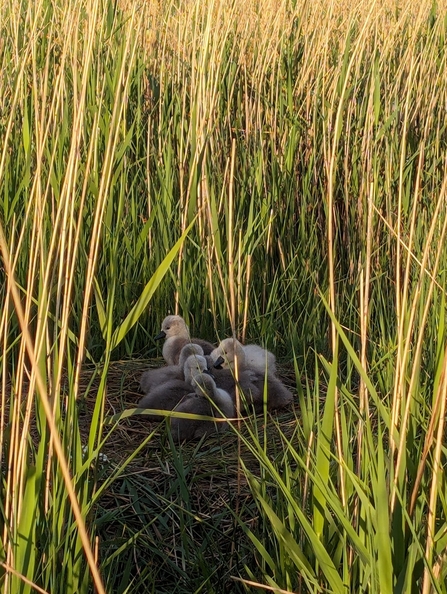
Cygnets observed on nest at Farlington © HIWWT
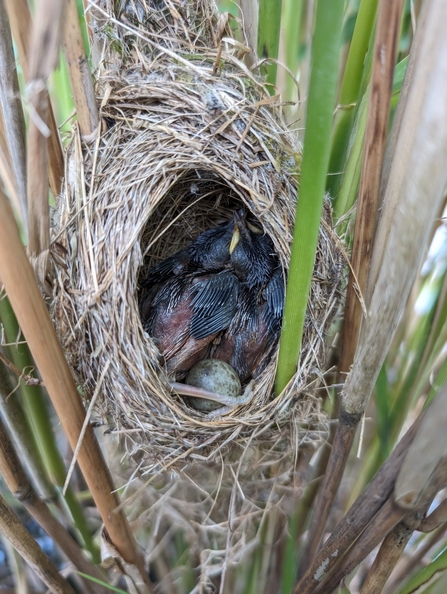
Reed warbler nest at Farlington © HIWWT
Farlington Marshes must be protected
Given the designations (national, European and international) there is a duty to protect Farlington Marshes and compensate for any loss of key habitats. If the sea wall around Farlington is breached, then the loss of the habitats and their function will need to be replaced. A new Farlington Marshes will need to be created. In theory, this can be done but it would take time, resource and most importantly the right site would need to be found. There is similar habitat scattered throughout the local area, but this is either itself threatened by sea level rise or is too small to provide the same functionality that Farlington does. Due to economic growth, and development (housing, industry, infrastructure) opportunities have been missed and the authorities are struggling to find any suitable compensation sites in the local area. We now find ourselves in a situation where we are working with statutory bodies, consultants and our landlord, Portsmouth City Council, to try and forge a way forward.
It is our view that Farlington Marshes must be protected for as long as possible until suitable compensatory habitat can be found and developed to replicate the scale and habitat complexity that Farlington Marshes currently offers. We accept that one day the site may be lost to the sea, but we need to ensure that the wildlife the site supports is not.The role Farlington plays in supporting avian life for Langstone, Portsmouth and Chichester cannot be overstated. If the nature reserve is lost, the impact on wildlife would be enormous and to the detriment of all three harbours. The local community will have also lost a vital green space, an area steeped in history, a place to connect with nature and be inspired by.


