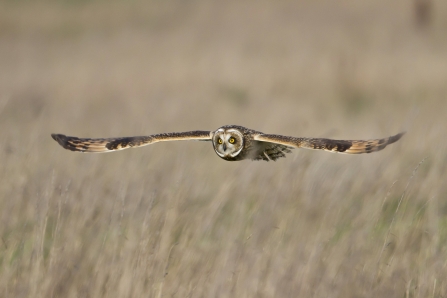

As the days shorten, resident short-eared owls are joined by migrants arriving from colder regions such as Scandinavia, Russia and Iceland. Some are even spotted flying in off the sea, arriving tired but determined after long journeys. These winter visitors spread out across open landscapes, particularly moorland, grassland, coastal saltmarshes and wetland edges, where hunting conditions are ideal.
The short-eared owl has a flight style unlike any other. Long-winged and buoyant, it glides low over the ground with steady, moth-like wingbeats, quartering the land as it searches for prey. Field voles are its favourite food, but small birds are also taken. Watching one hunt is a real privilege – silent, focused and graceful, it embodies the wildness of winter.
In appearance, short-eared owls are beautifully camouflaged. Their plumage is mottled yellow-brown above and paler underneath, blending perfectly with winter grasses and reeds. A pale face is framed by bold dark circles around striking yellow eyes, giving them an intense, almost curious expression. Despite their name, their ear tufts are very short and often barely visible, especially in flight.