Collecting seagrass from the Solent - A hands on account

This summer Hampshire & Isle of Wight Wildlife Trust collected more than 100,000 seagrass seeds from underwater meadows in the Solent. Diana Bonciu, Seagrass Restoration Intern, has written about her experience.

The alarm goes off at 5 am and, as I blindly reach over to turn off the offensive sound, I have to question all the choices I’ve made that have led to me being in this situation. When you’re bleary eyed and not fully awake, it’s hard to remember why you do this.  

30 minutes later, as we pull into the parking lot in front of our Seaview site on the Isle of Wight, I am immediately reminded. The sea is bathed in warm sunlight, peppered with black-headed gulls and the occasional heron. You can smell the salt on the breeze, and everything is calm and still. Who wouldn’t wake up early every morning if this was the view that greeted you?

seagrass meadow at Calshot

seagrass meadow at Calshot. Credit Helen Skelton-Smith

Soon, the marine team and eager volunteers have all gathered around with one goal in mind, seagrass seed collecting! As part of the seagrass restoration work, the Trust collects seagrass seeds each year over the summer months so that they can be planted during spring in order to expand already existing meadows in the Solent. 

Seed collection happens multiple times over the summer, sometimes twice a day, always at low tide, and it definitely wouldn’t be possible without volunteers. Some volunteers are true veterans that have been doing this for years and come to every session without fail, while others have only just found out about this and are eager to get started. Regardless, they are all excited as Ellie Parker, Senior Marine Officer, delivers the safety briefing and tells everyone what to look for and how to pick the seeds.  

Seagrass collection at Seaview, Isle of Wight.

Seagrass collection at Seaview, Isle of Wight. Credit Ellie Parker.

We all head down the beach, some of us in wetsuits, some in waders, or shorts and boots, having a mesh bag at the ready to collect seeds in. Just before reaching the low water line, however, one of our volunteers spots a weird looking slug, orange and full of bumps.  

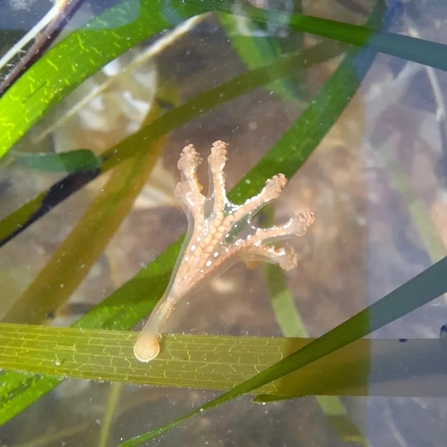
It is a Warty Doris (Doris verrucosa), a nudibranch that had eight delicate gills at its rear end and likes to feed on sponges that encrust rocks. This species was first reported in the UK in 2023 by one of our amazing volunteers and it’s considered quite rare. For us to just spot this little fellow on a beach we know so well is immediately exciting! As all the volunteers gather around to have a look, we notice two more individuals just on the next rock! We almost can’t believe our eyes! 

We ended up spotting some more in the coming days, and during a shore survey at Colwell, volunteers recorded 30 sightings! While incredibly exciting, their appearance could be a sign of rising sea temperatures.  

Orange, warty sea slug resting on a brown rock with green seaweed coming out from it

© Kate Garnham

Once we finally reached the water, the meadow becomes visible, right there just below the surface. Everyone quickly gets to work, finding a good patch and starting to pick the seeds. Sometimes, if the tide is out far enough, you can just sit down anywhere and there will be an abundance of spathes full of seeds in every direction. Other times, it is deep enough to snorkel with the meadow gently swaying beneath you. Regardless of tide height, it’s easy to spot that the meadow is brimming with life.  

Seagrass meadows play a very important nursery role for so many marine animals, from commercially important fishes to even the smallest nudibranchs. This is immediately evident as, while we’re picking seeds, we can spot tiny fish darting in and out of creeks in the meadow. Someone points out some cuttlefish eggs which are a bundle of dark beads with a pointed tip, attached to a seagrass shoot for protection from strong currents or predators. They can sometimes be called sea grapes, thanks to how they look, and when the babies hatch, they are miniature versions of their parents, ready to take on the world.  

Two people knelt down with white buckets on a green seagrass meadow

Seagrass Restoration Intern, Diana Bonciu, and Volunteer, Sue, collecting seagrass seed © Ellie Parker