
Grazers in Europe after the ice age
As the final ice melted towards the end of the last ice age, grazers spread throughout Europe. A diverse group of species, they included aurochs, red deer, wild boar, beavers and elephants. As they were hunted by man, numbers decreased, but diversity remained high as they made their home in the pre-Neolithic forests (somewhere between 25,000 and 12,000 years ago).
How prehistoric forests looked
Most argue that these forests were nearly completely closed canopy, with open spaces few and far between. Others argue that, during this time, grazers played a more prominent role, high enough in number to open up glades created by fallen trees - but not so high in number that other areas of forest couldn’t regenerate. This would create high biodiversity through cycles of succession. Whichever version of this is correct, pre-Neolithic forests were vast, with huge areas of woodland and natural regeneration.
Early humans and forest clearances
The arrival of the first early-modern humans across Europe brought with it the first forest clearances. This was in a time before agriculture: as glades and open spaces spread, grazers drove woodland-grassland processes and created a shifting mosaic of equally diverse habitats across the European landscape.
Life in the Neolithic forests
Moving into the Neolithic age, the age of farming, and small mixed farmsteads began to pop up. With time, farms were run with increasingly sophisticated and diverse management, varying by year, by county, by socioeconomics, by tenure, by technology and by demographic. Farming, and the landscape, entered a constant state of flux, emanating huge diversity, even within similar habitats.
Understanding the Neolithic forests
As we look back at this landscape, so far from the one we are familiar with today, what did 'forest' actually mean and what did this landscape look like beyond the farmsteads. Forests were open in the Neolithic age, a combination of mixed grassland, trees, shrub, rivers, and lakes. The term 'wood' was only ever used to describe timber used for building and firewood. The Neolithic landscape was an interconnected one, where species weren’t put into boxes based on habitat and were instead managed in an open landscape in a way that improved biodiversity rather than damaged it.
Population growth and farming changes
In the second century the population began to grow more rapidly; deforestation made way for arable land and firewood, and farms began to locally specialise. Seasonally grazed dens for pigs, heavily grazed vaccaries for cattle, as well as deer parks, all became popular ways to farm. However, the landscape remained generally mixed and open. Common grazing was frequently used, creating semi-natural habitats.
Controlling grazing in medieval times
As this became more prevalent and grazing levels increased, natural defences were lost, so control measures were put in place. These included closing hay meadows until late spring or early summer, placing extraction limits on coppiced woodland, protecting arable land from grazing until after the harvest or during fallow years. Grazing animals couldn’t be moved between different areas of woodland or given supplementarily feeding, capping populations to a natural carrying capacity. Medieval stints restricted grazing rights; they limited herd size, restricted the months areas could be grazed for, and limited the length of time areas could be grazed for. These restrictions meant that grazing-intolerant plants were offered a chance to battle on, and throughout this period we see the creation of many of the habitats we now consider to be habitats of conservation value, such as our chalk grasslands here in Hampshire.
The landscape did continue to change, and our terminology of the time reflected that; throughout the medieval period enclosed spaces were commonly grazed. As areas were increasingly closed off, protected, managed, there became a distinction between wood, meadow, and heath.
Farms and herds in the middle ages
Even though the landscape was beginning to fracture into separate habitats the period did still have cycles of land use. By the end of the Middle Ages (late 15th, 16th, and 17th centuries), farms were larger due to a more stable social structure. There were increases in herd sizes and fields became more fixed in place, but a complex mosaic of interdependent farming systems remained.
18th-century farming in Hampshire
Taking a closer look at Hampshire, by the 18th century, water meadows had been popularised, combining sheep and corn. Irrigation systems were springing up; downland was flooded, productivity increased, and sheep and grazing limits were expanded. Places like the New Forest only remained common grazing as the soil was generally too poor for crops.
Farming shifts and intensification
Beyond the 18th century, agriculture slowly shifted towards arable and intensification. Chalkland farming boomed at the turn of the century and large areas of downland were ploughed; sheep grazing areas reduced but intensified. Hedges appeared as downland was enclosed and beech shelters protected the remaining sheep. Food was grown on the more productive water meadows, and growing false fodder for sheep such as turnips comes into frequent use.
The decline of woodland management
By the 20th century woodlands weren’t used as much as they once had been and extraction was reduced: timber from coppicing was in decline, along with the use of firewood. The now enclosed, separated woodlands were managed less, grazed less and were dominated by a few specific, dominant species. Biodiversity was at an all-time low.
Loss of natural processes
We have seen a shift; dominant closed canopy forest with open glades have become a heterogeneous landscape, continually changing with high levels of extraction, managed woodlands, and extensive grazing. The landscape was then intensified, grazers were lost, spaces enclosed and connectivity disappeared. Increasing chemical inputs and supplementary feeding were the consequences as the landscape couldn’t hold growing stocking rates. Enclosing spaces, intensification and overgrazing has led to a significant loss of connectivity, and the loss of large herbivores and predators has led to the breakdown of natural processes, leaving biodiversity in tatters.
Restoring nature through grazing
So, what now? What do we do with a landscape that has become so disconnected and degraded?
One answer lies in restoring naturalistic grazing. Different grazers have different grazing techniques and different methods of disturbance. Some are tramplers, some are wallowers and some are good at snapping branches and de-barking trees.
How different grazers shape the land
There are many kinds of grazer, different species and breeds have been used differently over time. Here in Hampshire, we have seen the sheep-corn husbandry of the 18th and 19th centuries. Sheep are highly selective but agile, and they compact the ground with their delicate hooves. This prevents tree regeneration and creates a short tight sward.
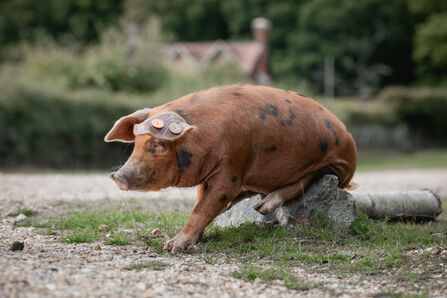
In the southeast of England, wood-pasture systems were more common during this time. These systems utilised pigs and cattle. Pigs are particularly good for ensuring the long-term sustainability of wood-pasture, by improving forest floor biodiversity and, in open spaces, supporting the germination of saplings. They are selective omnivorous grazers, they clear dense vegetation, create seedbeds and control weeds, but they also compact soil. This can damage tree roots and prevent tree regeneration when grazing in enclosed spaces.
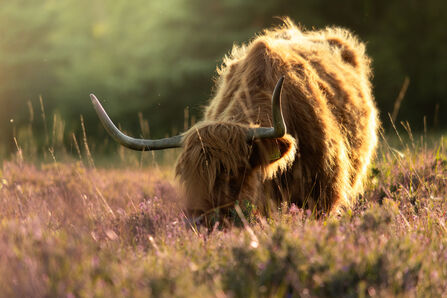
Cattle bring different characteristics again: being large and heavy they can manage excess scrub and support tree regeneration in woodlands. They are also able to open up woodlands, decreasing the dominant species which have grown up since we lost our woodland management. Cattle are unselective and good for retaining diversity through the disturbance they cause by trampling. They create an uneven, tussocky sward with lots of micro-habitats.
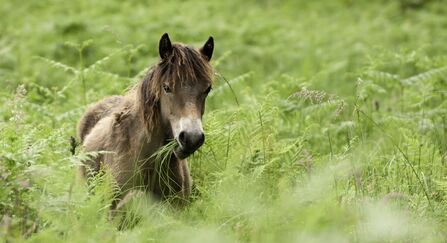
Ponies are selective grazers, they create a varied, open, herb-rich sward. Goats are browsers and eat high quality grasses and trees, control bramble and thorn but eat tree seedlings. They also create an uneven tussocky sward.